Foggy Bottom · A hidden history

The block they
couldn’t tear down.

Fog, gasworks, a bootlegging gang, the Watergate, and a barbershop that has cut hair in Foggy Bottom since 1960. The story of one of Washington’s most famous and least understood neighborhoods, told from a chair at the corner of 21st & I.

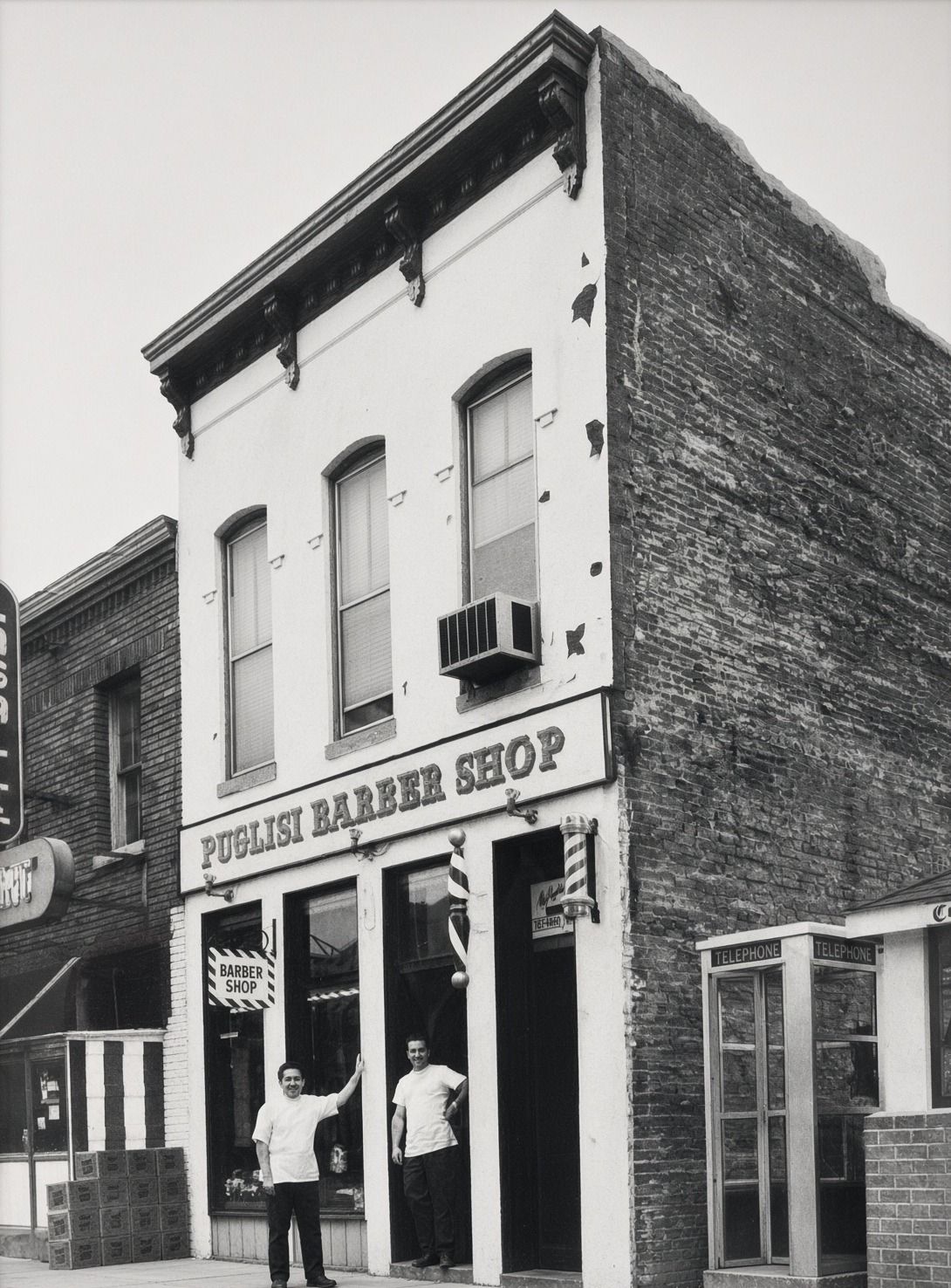
Photo: the original Puglisi Barber Shop, from the shop’s own collection.

The original Puglisi Barber Shop: a two-story painted storefront with a PUGLISI BARBER SHOP sign, two barber poles, two barbers in white shirts at the door, and a telephone booth beside it
01 / The name

A name nobody can pin down.

Foggy Bottom is one of the best-known neighborhood names in America, and nobody can say for certain where it came from. Not the encyclopedias, and not the city’s own planners. The name surfaced sometime in the 19th century and was already in the local press by the 1870s.1

The best guess, according to the DC Office of Planning, is that locals used it for the swampy “bottom land” along the Potomac, where natural river fog mixed with the smoke and soot of the factories on the bank.2 In other words, the most famous fog in Washington was partly smog. To understand how a waterfront of furnaces and gas tanks became a neighborhood of diplomats, students and the Kennedy Center, you have to start long before the fog rolled in.
02 / Hamburgh

Before the fog: a town called Hamburgh.

In 1765 a landowner of German descent named Jacob Funk bought 130 acres near where Rock Creek meets the Potomac. He called the plot Hamburgh, laid out a street grid in 1771 and split it into 234 lots.1 Locals called it “Funkstown.”2 The town never really took off. When the District of Columbia was created in 1791, Hamburgh was folded into the new capital, and by 1800 the whole area had only 27 habitable buildings.1

The neighborhood’s first public square was a market. In 1803 Western Market opened on a triangle of land on Pennsylvania Avenue, in what is now the small park facing the 2000 block of I Street. In 1822 it gained a second story that served as Foggy Bottom’s town hall: a schoolroom, a polling place, and the site of temperance rallies, balls, fairs and political meetings.3 Keep that block in mind. It comes back later in this story.

03 / Industry

Glass, gas and beer.

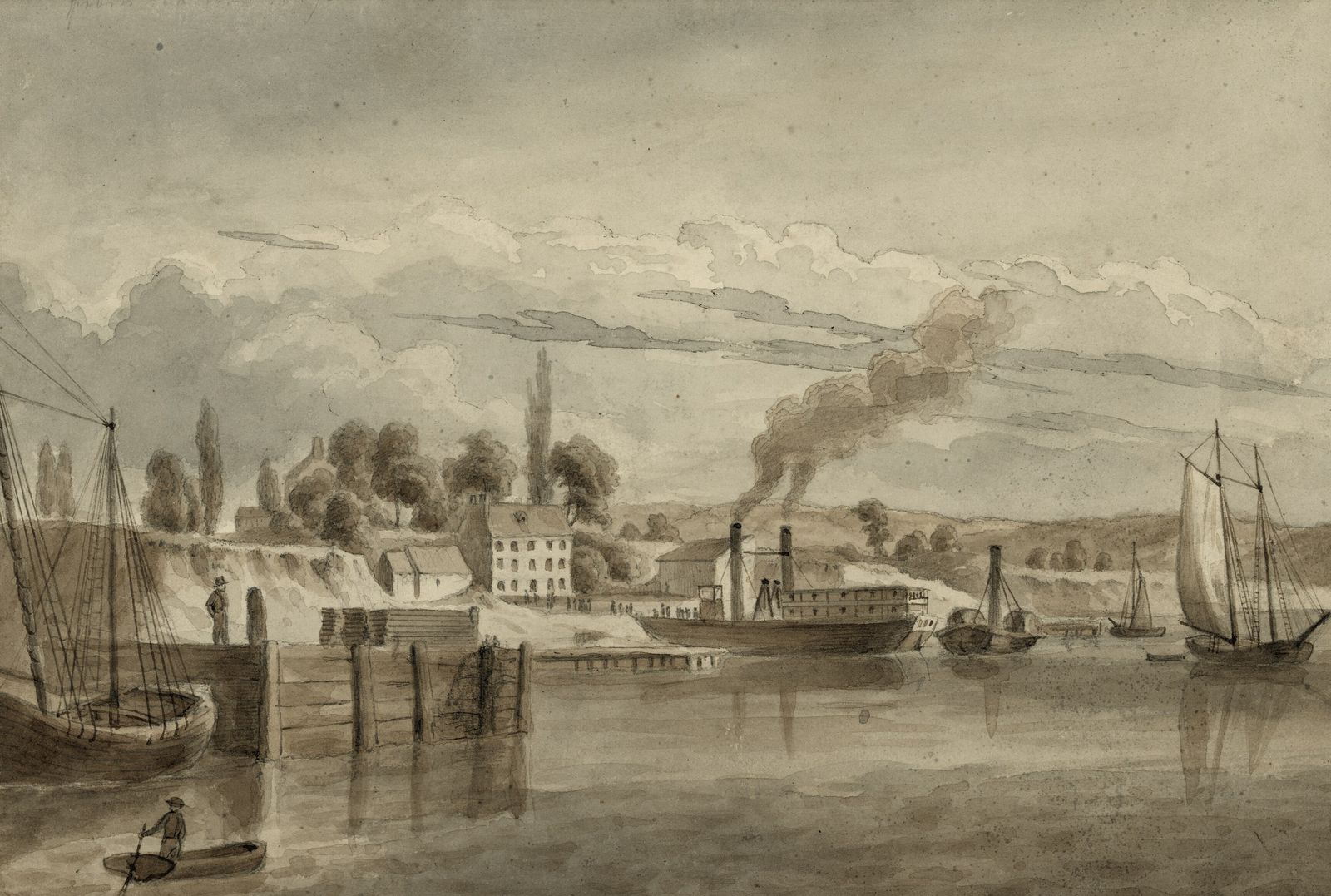
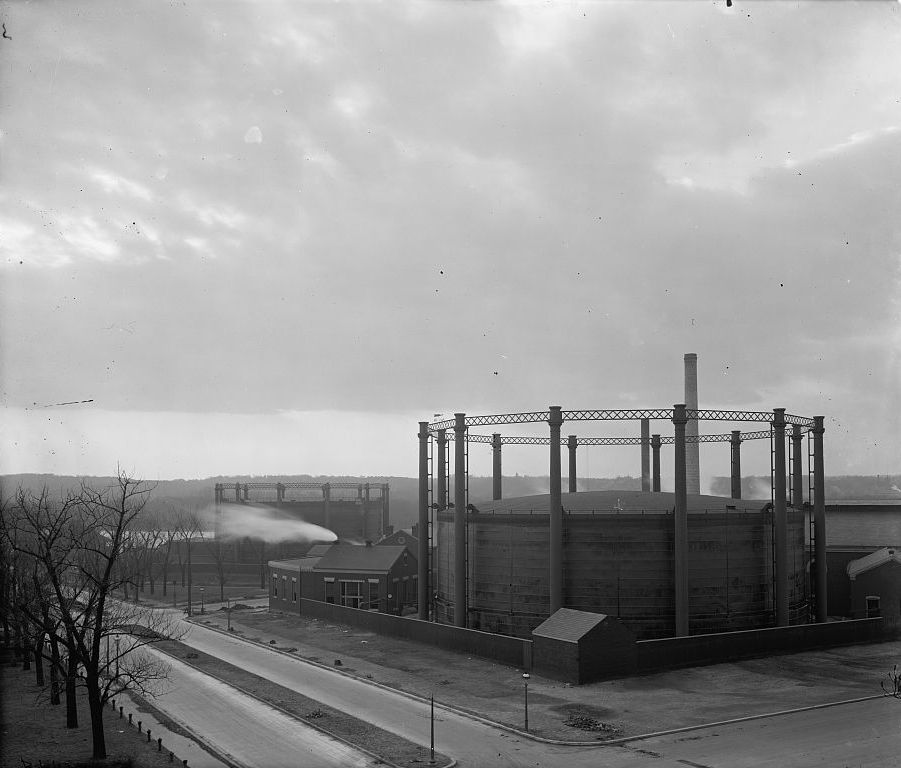
Industry came first by water. A glass factory known as the Glass House opened on the riverbank in 1807 and made glass until 1833.1 The Chesapeake and Ohio Canal, completed in 1837, brought coal, limestone and more business to the waterfront.1 The biggest arrival was the Washington Gas Light Company, which began building in Foggy Bottom in 1856 to make coal gas for the city.1

Wash drawing of the Washington steamboat wharf in 1839, with sailing ships, a smoking steamboat and waterfront buildings
The Washington waterfront and the Glass House, 1839, in a wash drawing by Augustus Köllner. Augustus Köllner · Public domain · source

Then came the beer. German immigrant Christian Heurich founded his brewing company in 1872, and it grew into a major regional producer and employer.1 According to the Office of Planning, Germans labored at the glassworks and breweries while the Irish tended to work at the gas company.2 By 1860, unskilled workers made up 42 percent of Foggy Bottom’s population.1 Blocks of plain brick rowhouses went up to house them, many of which still stand in the Foggy Bottom Historic District.1

Black-and-white photograph of a huge gas holder frame beside rail tracks at 26th and G Streets in 1905
Washington Gas Light Company tanks at 26th & G Streets, 1905. The Watergate stands on this land today. Harris & Ewing, photographer · Public domain · source
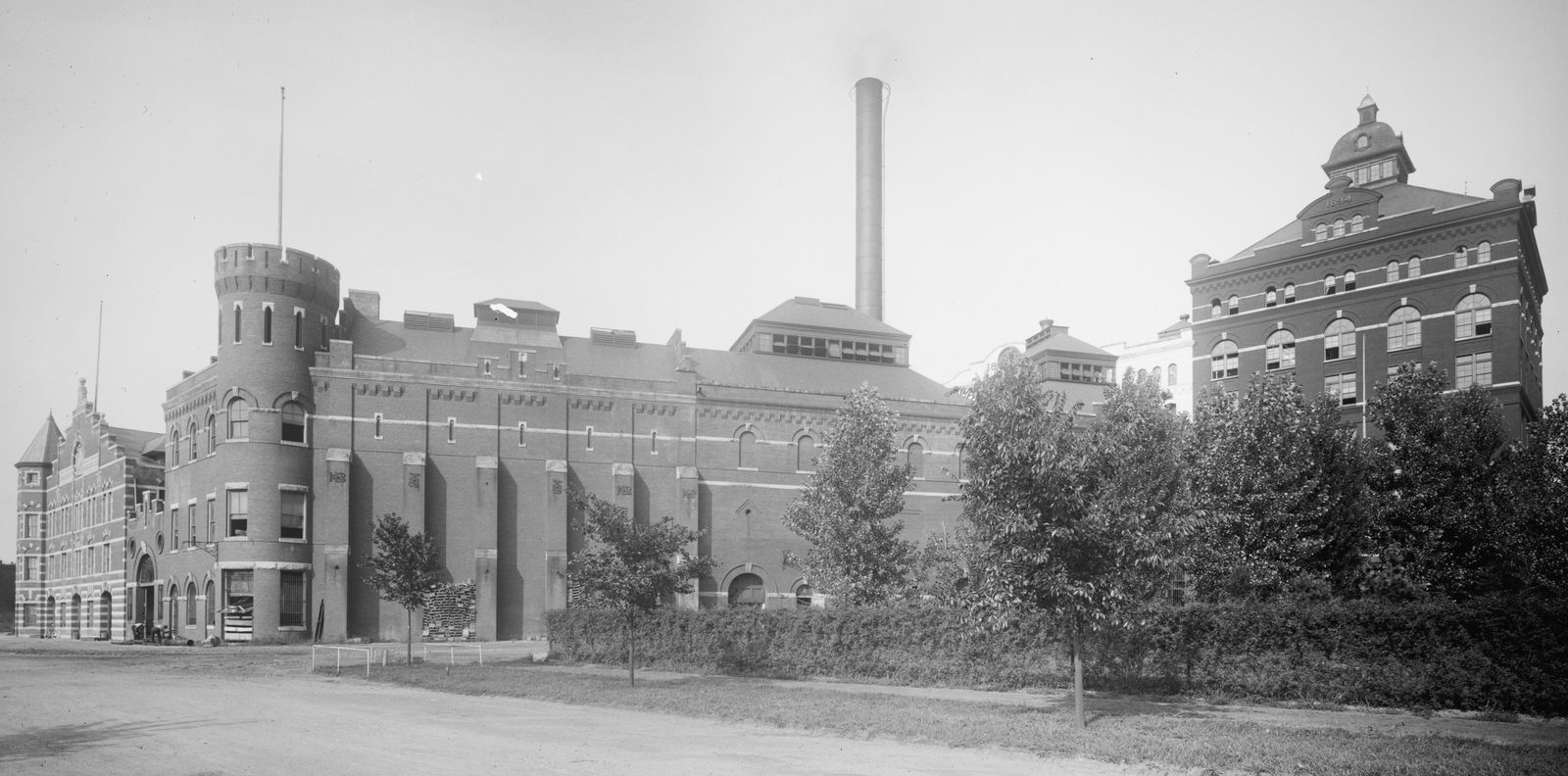
Black-and-white photograph of the castle-like Christian Heurich Brewing Company building with a tall smokestack, 1910
The Christian Heurich Brewing Company, 1910. National Photo Company Collection · Public domain · source
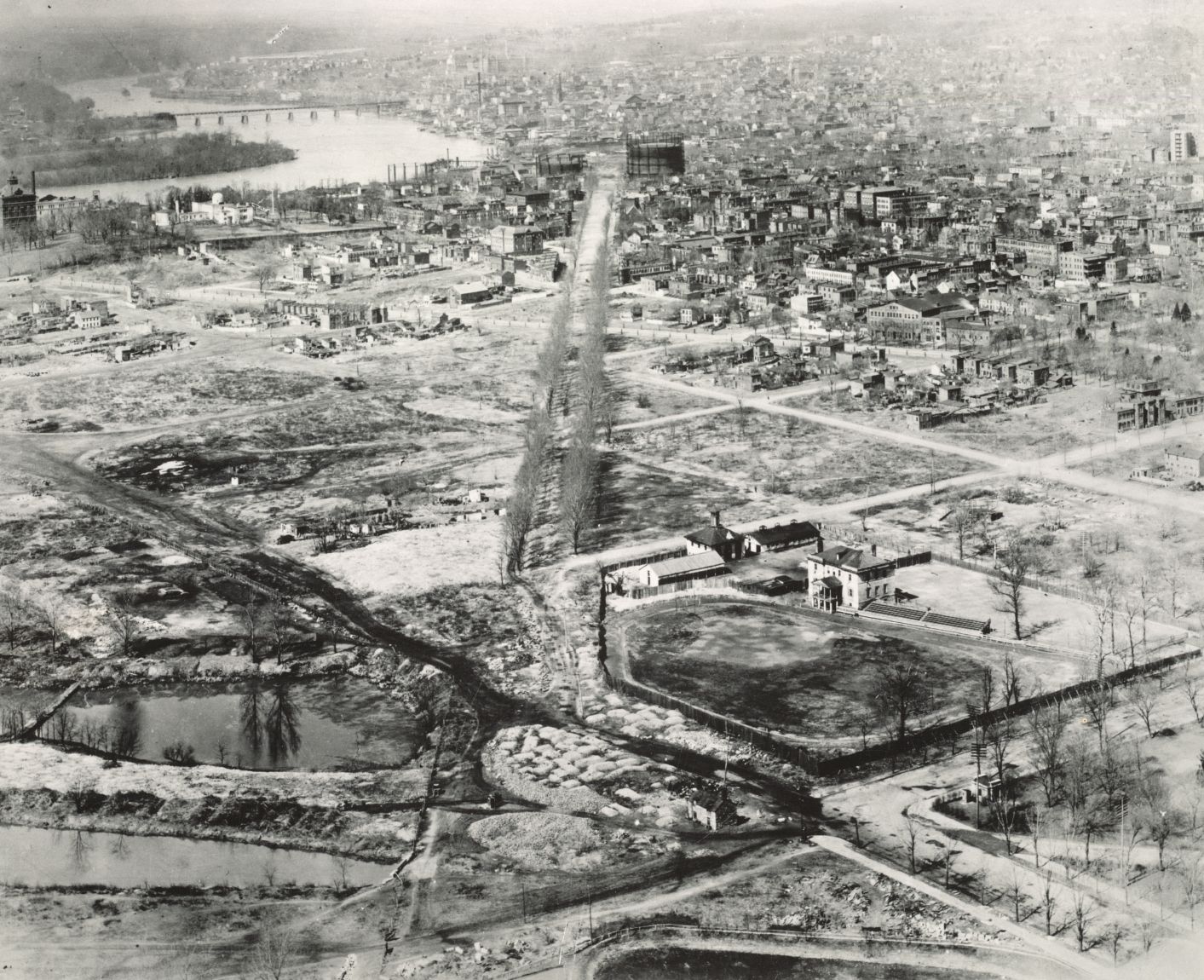
Aerial black-and-white view looking toward Foggy Bottom from the Washington Monument, with the brewery and gas tanks in the distance
Looking toward Foggy Bottom from the Washington Monument in 1894. Heurich’s brewery is at top left; the gas tanks are at the end of Virginia Avenue. Cornell University Library, A. D. White Architectural Photographs · No known copyright restrictions · source
04 / The alleys

The alleys, and the people pushed out.

Behind the street-front rowhouses was a second city. Alley dwellings, simple two-story brick houses and shanties without basic sanitation, appeared in the 1860s. By the 1870s Washington’s alley communities were majority Black, and by the 1890s Foggy Bottom had nine inhabited alleys. Some, like Snows Court and Hughes Court, held hundreds of people in cramped conditions.1

Prohibition gutted the breweries that had employed so much of the neighborhood. Heurich’s survived by making ice and leasing space for storage.1 It also gave rise to what the local press called the Foggy Bottom Gang. Run by the Warring brothers, Charles “Rags,” Emitt “Little Man” and Leo, it ran bootlegging and illegal gambling, and some of its distilling and rum-running happened in Foggy Bottom’s alleys. It lasted until an FBI crackdown on gambling in the 1950s.1

Then came the clearances. In 1935 the federal Alley Dwelling Authority began demolishing Foggy Bottom’s alley homes, starting with 56 houses in O’Brien’s Court that became parking lots. The people displaced were mostly Black residents. Foggy Bottom was still majority Black in 1950. By 1960, rising property values and the clearing of low-income areas had made it a largely white, middle-income neighborhood.1

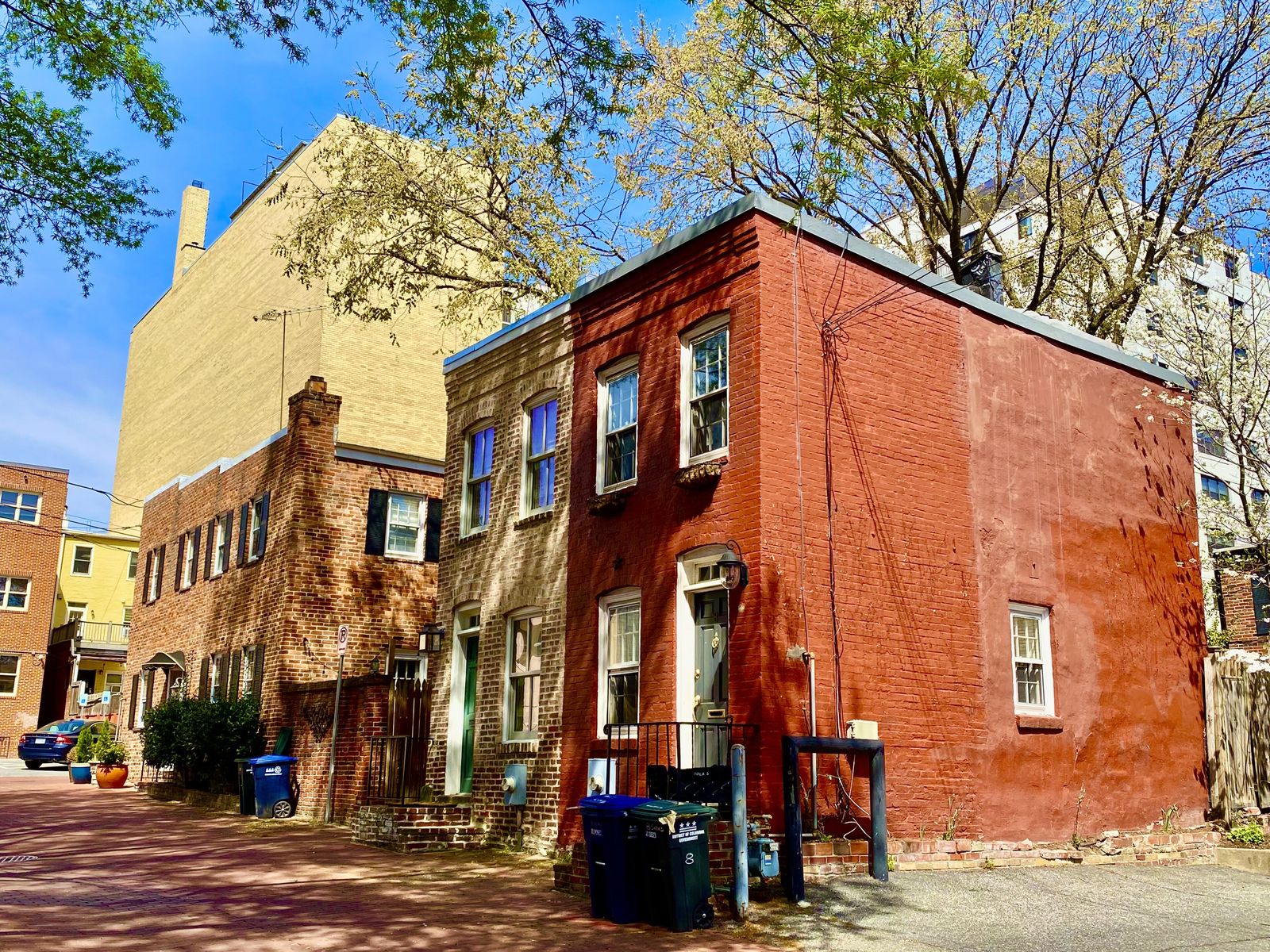
Small red-brick two-story alley houses along a brick-paved lane in Snows Court, Foggy Bottom
Alley houses in Snows Court, built around 1884, still stand inside the Foggy Bottom Historic District. Wikipedian1234 · CC BY 4.0 · source
05 / 1960

1960: the year everything turned.

The modern neighborhood began with two events in 1947. The State Department moved into new quarters in “an area known as Foggy Bottom,” as its own history puts it,9 and the Washington Gas Light Company dismantled its plant. The last gas tanks came down in 1954.2

By 1960 the turn was complete. The Heurich brewery made it to that year and no further.2 The State Department’s huge extension was finished in 1960.10 On I Street, the Foley Company bought 2022 I Street, the house whose demolition would start a preservation war sixteen years later.5

And on April 23, 1960, a young Sicilian barber and his uncle-in-law opened a shop in a townhouse at 2143 Pennsylvania Avenue.11 Tony Puglisi had trained as an apprentice in Sicily after World War II because his mother wanted him to learn a trade. “I watched them cut hair every day,” he told DCist. “Then, one day, they told me I was ready.” He cut hair in Rome, then came to Washington in 1960 with his wife, Virginia, speaking no English.11 A haircut cost $1.50. “When we went up to two dollars, everyone complained, just like they do today,” he said.11

“The neighborhood has changed a lot. Night and day. In 1960, it was a place of low income.”
Tony Puglisi · WJLA, July 2019
06 / Concrete

Highways, a palace and the Watergate.

The 1960s hit western Foggy Bottom like a wrecking ball. In 1961 much of it was demolished for what became the E Street Expressway, and the Heurich brewery, which by then housed Arena Stage, was torn down for the Theodore Roosevelt Bridge, finished in 1964.1

Much of the brewery’s old site became home to a national cultural center.8 In December 1964 President Lyndon Johnson broke ground with the same gold-plated spade used for the Lincoln Memorial in 1914 and the Jefferson Memorial in 1938, and the Kennedy Center opened on September 8, 1971, with the world premiere of Leonard Bernstein’s Mass.7

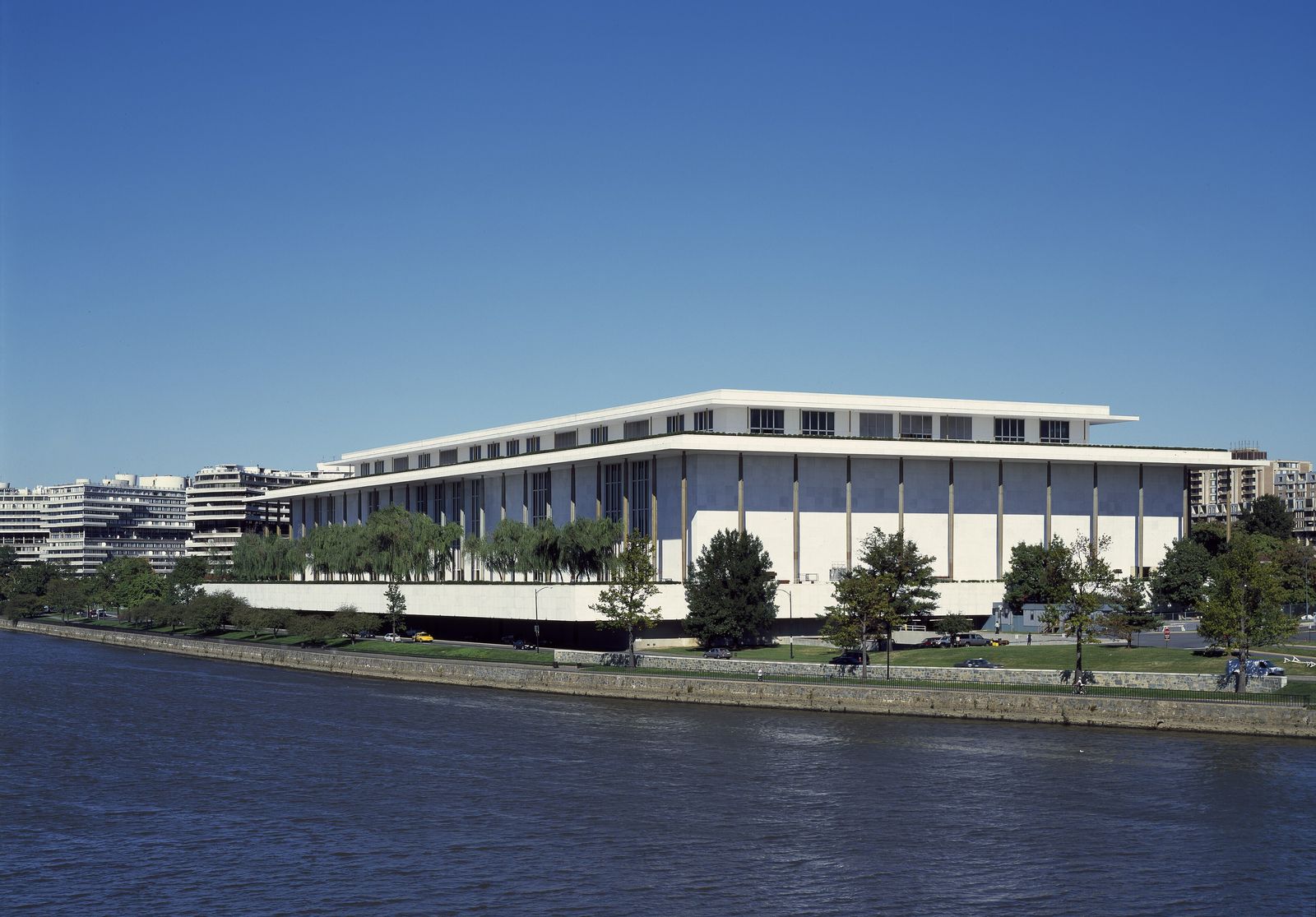
The white marble Kennedy Center on the bank of the Potomac River under a blue sky
The Kennedy Center on the Potomac, photographed by Carol M. Highsmith. Carol M. Highsmith · Public domain · source

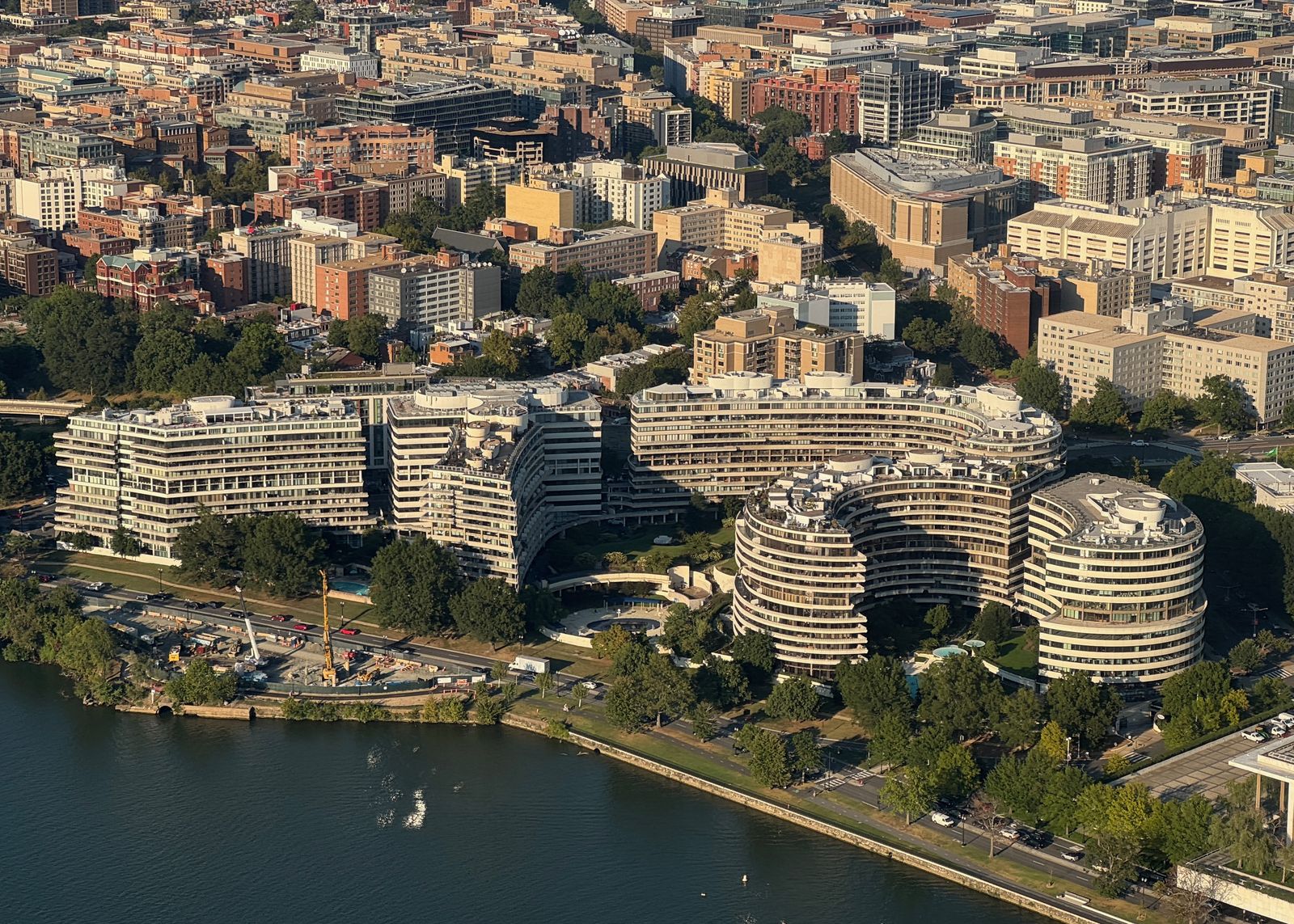
Next door, on land that had belonged to the gas works for more than a century, rose the Watergate. It was built between 1963 and 1971 by a Rome-based developer, Società Generale Immobiliare, whose investors included the Vatican.6 In 1972 its office building gave its name to the scandal that brought down a president, and the suffix “-gate” to countless scandals since.6 The Watergate even had a barber connection. One of the barbers now at Puglisi’s, David, had cut hair at the Watergate and the National Press Club before Tony recruited him, DCist reported in 2019.11

Through all of it, the little shop on Pennsylvania Avenue kept cutting. The 1970s were the real threat: long hair meant fewer haircuts and killed many barbershops. Puglisi’s survived because Tony’s uncle-in-law owned the building (he sold it in 1982) and because both men knew how to cut long hair. “It’s about framing the face,” Tony said.11 In 2004 The GW Hatchet wrote that the shop had seen “scores of demonstrations protesting U.S. involvement in wars from Vietnam to Iraq.”13 Meanwhile the neighborhood emptied out: between 1970 and 1984, Foggy Bottom’s population fell from 14,500 to 9,100.1

Aerial view of the curving Watergate complex beside the Potomac River with Foggy Bottom behind it
The Watergate from the air, September 2025. The gas works once stood here. PRRfan · CC BY-SA 4.0 · source
07 / Red Lion Row

The block they couldn’t tear down.

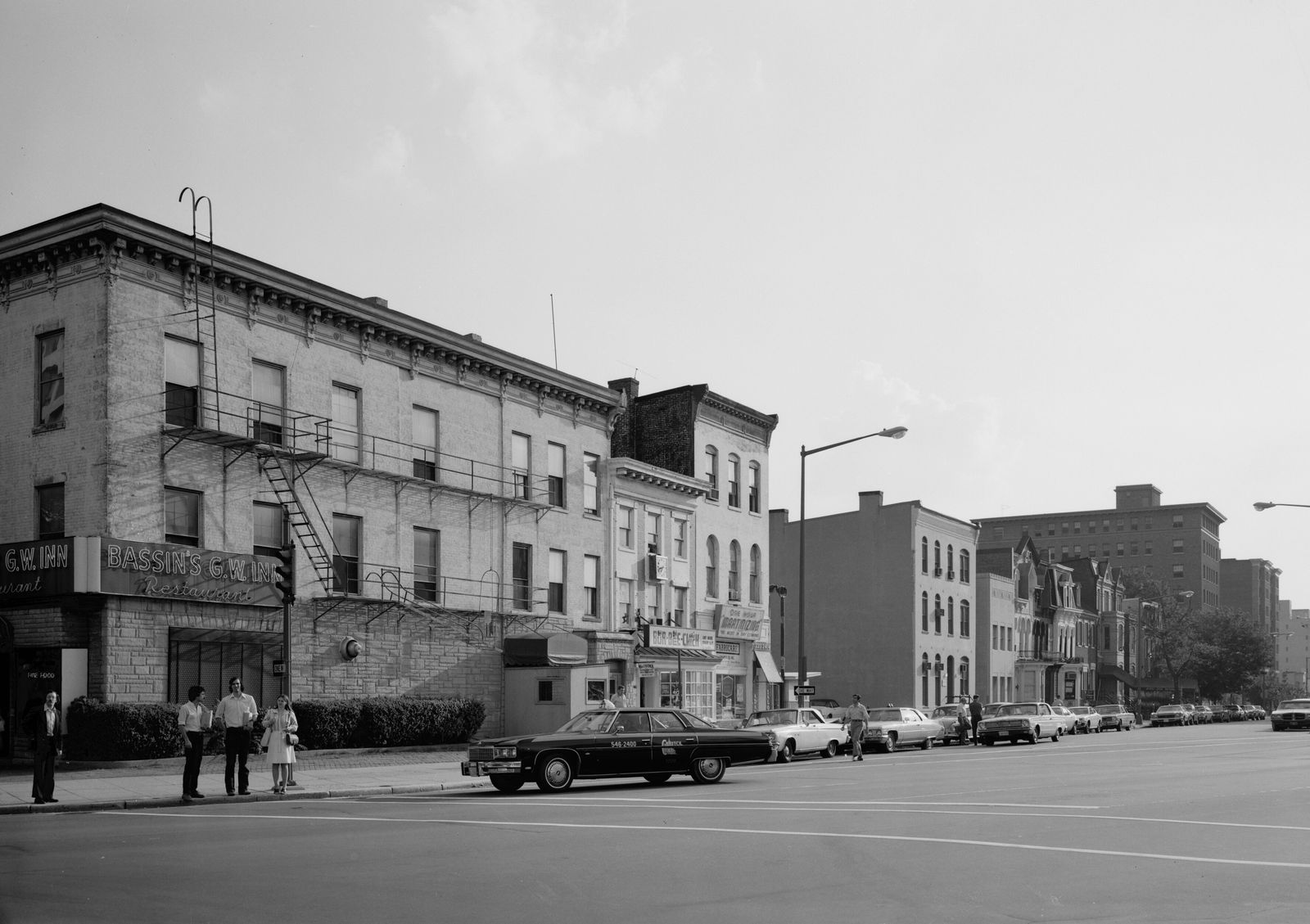
Remember Western Market? Facing it, on the south side of the 2000 block of I Street, stood a row of thirteen buildings built between 1831 and 1896. Because the market was so close, most of the people who lived there were merchants and artisans, and many kept shops in their homes.3 Two of the houses, 2022 and 2024 I Street, were built in 1874 and 1875 by Alexander Robey Shepherd, DC’s former territorial governor.3 The corner building, 2040 I Street, and its neighbor at 825 21st Street were finished in 1879 by Robert Earl, a man who ran a livery stable nearby for more than forty years.5

Black-and-white survey photograph of a row of 19th-century commercial buildings along I Street with parked cars
The 2000–2042 I Street commercial block before the 1980s office complex, from the Historic American Buildings Survey. Historic American Buildings Survey, Library of Congress · Public domain · source

By the 1970s the block was known as Red Lion Row, after Lindy’s Red Lion pub.3 In October 1976 the developer that owned several of the houses began demolishing 2022 I Street. A preservation group founded in 1971, Don’t Tear It Down, won a court order to stop it.5 The block was added to the DC Inventory of Historic Sites in January 1977 and the National Register of Historic Places that August.4 The fight dragged on through more restraining orders and an injunction until DC passed its historic preservation law in 1978, which saved the buildings.5

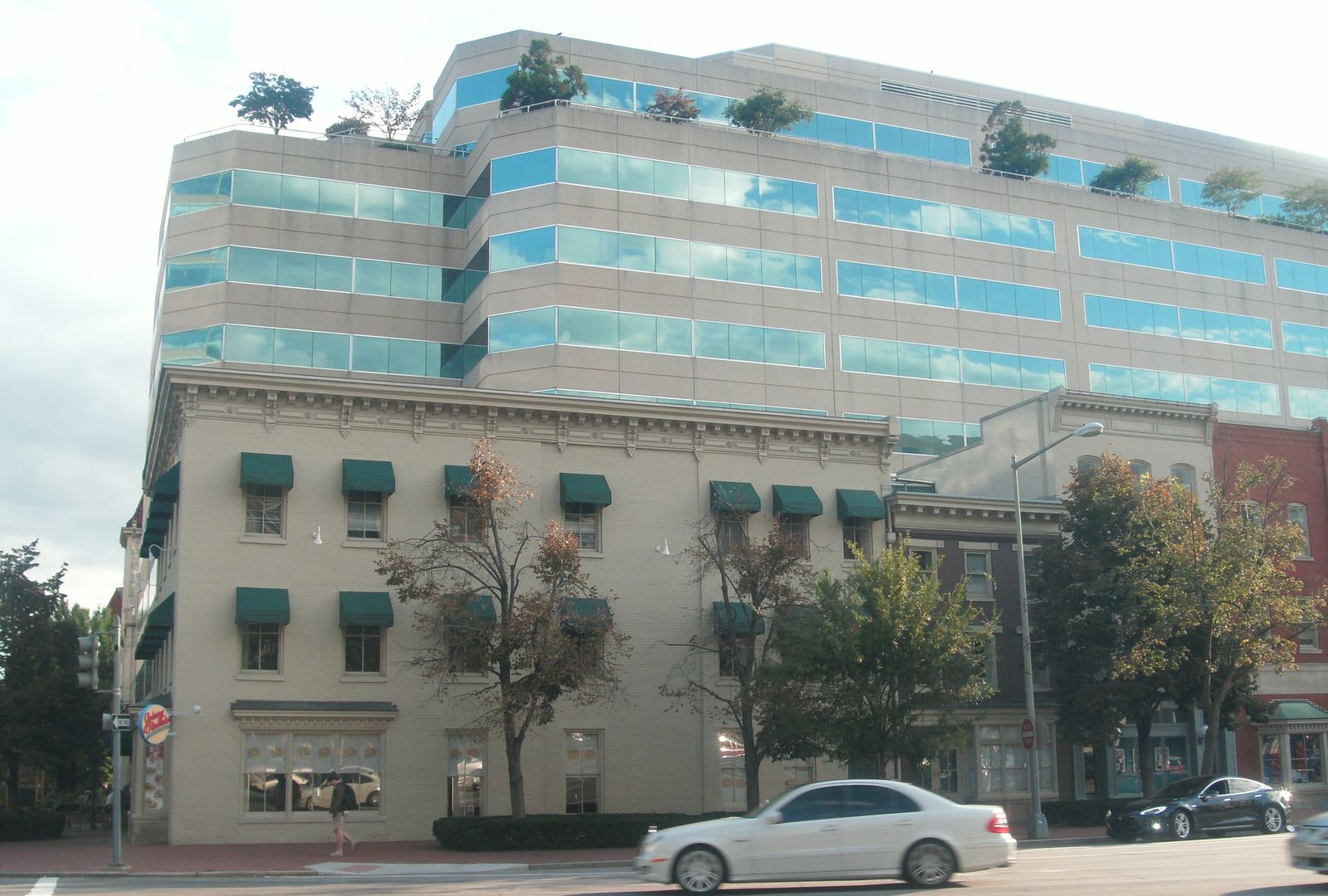
George Washington University then bought the row and agreed to keep the facades in front of a new eight-story building.3 Construction in 1982 and 1983 knocked down the backs of the houses and kept their fronts, and it was the first time partial demolition had been used in Washington.5 Look up from the sidewalk today and you are seeing the 19th-century merchants’ row, with the 1980s building behind it. One more detail: 2040 I Street is the only building on the block that GW does not own.5

Corner of 21st and I Streets showing the preserved 19th-century corner buildings with the 1980s office building rising behind them
The corner units at 2040 I St NW and 825 21st St NW in 2013, with the 1983 office building behind them. AlbertHerring · CC BY-SA 3.0 · source
08 / 21st & I

Down the stairs at the corner of 21st & I.

About thirty years after opening, the shop moved across Pennsylvania Avenue to 2100 Pennsylvania Avenue.11 It became part of campus life. Former GW president Stephen Joel Trachtenberg told The Hatchet he got about six haircuts a year there, and Tony recalled about 50 ROTC cadets coming in to have their heads shaved at once, sent in ten at a time.13 By 2017 his barbers had cut the hair of the past four university presidents.14

Then the neighborhood came for the shop again. In 2017 GW planned to redevelop 2100 Pennsylvania Avenue, and Tony, then 57 years in the area, said he hoped to stay close because rents elsewhere were so high. “If I had to leave the area, I’m not going to reopen the shop,” he told The Hatchet.14

“If we move, yeah they lose something. The neighborhood – they lose something.”
Tony Puglisi · The GW Hatchet, October 2017

He didn’t have to leave. Lindy’s Red Lion closed in June 2018 after decades as a campus staple,15 and in 2019 Puglisi’s moved into the former Lindy’s Red Lion space, an English basement at 2040 I Street.11 “We are just barbers,” Tony said. “Rent goes up, so we have to move. But it’s okay.”11 Even the Foggy Bottom Association’s history of the block now notes that the old pub “now houses the Puglisi barber shop.”3

So a barbershop that opened in 1960, the year the Heurich brewery closed, now works below an 1879 corner building on the block that preservationists refused to let the bulldozers take. In 2019 DCist reported that Abel had been hired at 19, thirty years earlier, and that José was coming up on 31 years with Tony.11 Today the barbers are Tony, Abel, José and David.

Small shops in Foggy Bottom still have it hard. A 2023 study cited by The Hatchet found a 63 percent storefront vacancy rate in the area. In 2025, Puglisi’s was one of six local businesses awarded a $4,000 Foggy Bottom and West End Main Street grant to upgrade their spaces.16 Asked the secret to a good haircut, Tony’s answer hasn’t changed in sixty-six years: “Just listening to people.”11

Visit

Come down the stairs.

Puglisi HairCuts · 2040 I St NW, Washington, DC 20006 · downstairs at the corner of 21st & I · (202) 833-2175

Hours

Mon–Fri · 8am–6pm
Sat · 8am–5pm
Sun · Closed

Prices · cash only

Haircut $40 · Shampoo & Cut $50
Haircut & Beard $60 · Beard Trim $30
Shave $50

Getting here

Walk-ins welcome. About five minutes on foot from Foggy Bottom–GWU Metro. We also speak Spanish, Portuguese, French and Italian.

Hours & map → Directions ↗

FAQ

Foggy Bottom, briefly.

Why is it called Foggy Bottom?

Nobody knows for certain. The name was in use in the local press by the 1870s. The DC Office of Planning says it probably described the swampy “bottom land” along the Potomac, where river fog mixed with smoke and soot from the gasworks, breweries and other factories on the waterfront.

What is Red Lion Row?

Red Lion Row is the row of thirteen 19th-century buildings, built between 1831 and 1896, on the south side of the 2000 block of I Street NW. Preservationists stopped its demolition in the 1970s, and George Washington University kept the facades in front of a new office building completed in 1983. It takes its name from Lindy’s Red Lion pub, whose former space at 2040 I St NW is now home to Puglisi HairCuts.

What was the Watergate built on?

The Watergate was built between 1963 and 1971 on land that had belonged to the Washington Gas Light Company’s gas works for more than a century. Gas production there stopped in 1947.

What happened to the Heurich brewery in Foggy Bottom?

Christian Heurich’s brewery survived Prohibition by making ice and leasing storage, and lasted until 1960. It was torn down during construction of the Theodore Roosevelt Bridge, and much of its former site is now occupied by the Kennedy Center, which opened in 1971.

Is there an old-school barber shop in Foggy Bottom?

Yes. Puglisi HairCuts has been cutting hair in Foggy Bottom since April 23, 1960, and is now at 2040 I St NW, downstairs at the corner of 21st & I. Walk-ins only, cash only. A haircut is $40, a shave $50. Open Mon–Fri 8–6 and Sat 8–5; call (202) 833-2175.

Sources

Where every fact comes from.

  1. “Foggy Bottom.” Wikipedia. en.wikipedia.org/wiki/Foggy_Bottom
  2. DC Office of Planning, Historic Preservation Office. “Foggy Bottom Historic District” brochure. planning.dc.gov (PDF)
  3. Foggy Bottom Association. “Funkstown No 5. Western Market Reborn,” Nov 20, 2021. foggybottomassociation.org
  4. DC Preservation League. “Red Lion Row (I Street, NW, South Side of 2000 Block).” DC Historic Sites. historicsites.dcpreservation.org
  5. “2000 Pennsylvania Avenue.” Wikipedia. en.wikipedia.org/wiki/2000_Pennsylvania_Avenue
  6. “Watergate complex.” Wikipedia. en.wikipedia.org/wiki/Watergate_complex
  7. The John F. Kennedy Center for the Performing Arts. “History.” kennedy-center.org
  8. Frank Leone, Foggy Bottom Association. “Funkstown: Connecting the City to Foggy Bottom’s Kennedy Center,” Feb 29, 2024. foggybottomassociation.org
  9. U.S. Department of State, Diplomatic Reception Rooms. “Containment and Cold War” timeline. diplomaticrooms.state.gov
  10. U.S. General Services Administration. “Harry S. Truman Federal Building, Washington, DC.” gsa.gov
  11. Matt Blitz, DCist. “This Italian Immigrant Has Been Barbering In Foggy Bottom For Nearly Sixty Years,” Jun 17, 2019. dcist.com
  12. Caroline Patrickis, WJLA. “‘It only cost $1.50’ Italian immigrant has been cutting hair in Foggy Bottom for 60 years,” Jul 31, 2019. wjla.com
  13. Andrew Siddons, The GW Hatchet. “Making new waves: the history of Puglisi’s barbershop,” Mar 29, 2004. gwhatchet.com
  14. Justine Coleman and Cindy Bae, The GW Hatchet. “Small businesses concerned about uncertain future as GW plans investment project,” Oct 2, 2017. gwhatchet.com
  15. Lindsay Paulen, The GW Hatchet. “Barbershop to replace Lindy’s Red Lion in The Shops at 2000 Penn,” Mar 21, 2019. gwhatchet.com
  16. Ryan J. Karlin, The GW Hatchet. “Six local businesses earn $4,000 in Main Street grants,” Aug 25, 2025. gwhatchet.com

Photographs: the opening photograph of the original Puglisi Barber Shop is from the shop’s own collection. All other photographs are public domain or used under Creative Commons licenses, credited in each caption with a link to the original file. Resized copies of CC BY-SA images are shared under the same license.